

New research shows the importance of high-quality coach training in learner persistence and success
From time to time, we tap into the expertise of our InsideTrack team and ask them to share insights on a student support topic they’re passionate about. This week, we turn our blog over to Dr. Mandalyn Gilles, InsideTrack’s Director of Research Solutions, to share more on an evidence-based, peer-reviewed publication she co-authored.
What makes coaching great? Quality training.
Table of contents:
- Better learner outcomes begin with exceptional coaching competencies
- Four components of InsideTrack’s Coaching Model Theory of Change
- Why trusted human connections drive positive results
Student success coaching is ubiquitous, found in colleges, universities and even workplaces across the globe. Many organizations invest in coaching with the hope of helping learners persist and complete, but outcomes can vary widely because not all coaching programs are created equal.
With uncertain funding models, fluctuating enrollment trends and evolving student demographics affecting every corner of higher education, institutions aren't in a position to invest in student support solutions that only might work. They need evidence-backed solutions that will help them produce strong learner outcomes and contribute to long-term ROI.
Having spent over three years at InsideTrack as Director of Research Solutions, focusing on coaching efficacy, social impact and learner success — and a total of 15 years in the edtech and higher education sectors — I have seen how important human intervention and connection is in order for a coaching program to be truly effective. However, the coaching field has often lacked a unified, scholarly framework that explains how that success happens.
Recently, I’ve been partnering with researchers Dr. Amady Sogodogo and Dr. Heather Harris from Herkimer Consulting to seek an objective understanding of the drivers behind positive student outcomes and evaluate how high-quality training programs can use empirical literature to create a direct link between coach competencies and long-term benefits for learners. Our work has culminated in a peer-reviewed study published in the International Journal of Mentoring and Coaching in Education titled, “Empirical support for the InsideTrack coaching model: findings from an integrative review of the literature.”
This publication represents an industry-first: InsideTrack is the only coaching program with a Coaching Model Theory of Change (TOC) that explicitly highlights evidence of effectiveness. By establishing this foundational roadmap, we are setting a new bar for rigor in student support interventions.
The InsideTrack Coaching Certification (ICC) program was used as a case illustration in this research, though it’s important to note that this literature review was not a study of InsideTrack data. Rather, we conducted an integrative review of the coaching literature to determine what constitutes "quality coaching" and how those findings align with established training frameworks.
Ultimately, this review finds that truly effective coaching, which directly impacts learner outcomes, requires the proper development of coaches’ competencies.
The publication’s big idea:
Quality training builds specific coaching knowledge, skills and beliefs (i.e. deep listening and empathy) → Those competencies allow coaches to build a safe environment to have effective interactions with students → Those interactions give students the confidence and tools to stay in school and reach their goals.
In short: Better training makes better coaches, and better coaches empower successful students.
Better learner outcomes stem from exceptional coaching competencies
Coaching works — but how it works matters
Across academic and workplace settings, we found that high-quality coaching consistently shows positive effects on learner outcomes. When done well, it serves as a powerful tool for boosting student:
- Persistence and retention
- Self-efficacy and confidence
- Goal attainment
- Well-being and motivation
- Positive growth mindset and resilience
However, the literature also shows us that poorly trained coaches can reduce the effectiveness of an intervention or even negatively impact the learner experience. This underscores the critical importance of structured, evidence-based coach training programs.
Development of coaches’ knowledge, skills and beliefs is the link to student success
Our publication demonstrates strong empirical support for the development of core competencies that are emphasized in the InsideTrack Coaching Certification (ICC) program, including:
- Relationship building: Establishing a foundation where learners feel safe to share their challenges
- Active listening and powerful questioning: Moving beyond surface-level check-ins to understand the student's "why"
- Reflection and feedback loops: Creating space for learners to pause, reset and learn from their experiences
- Goal setting and action planning: Helping learners take accountability and set tangible steps to reach their aspirations
- Emotional intelligence (EI) and diversity intelligence (DQ): Equipping coaches to recognize and validate the unique lived experiences of every learner
We found that coaches who develop these competencies are better able to create a trusted human connection with their learners, which ultimately drives stronger student outcomes. The research shows that trust, psychological safety and feeling understood are central to learner success.
Four components of InsideTrack’s Coaching Model Theory of Change
Aligning with empirical evidence and outlining a roadmap to student impact
This research brings together a cohesive Coaching Model Theory of Change (TOC). Rather than looking at coaching in isolation, this model illustrates that student success is the result of a deliberate, research-confirmed chain of events: High-quality coach training leads to stronger coach competencies, which results in higher-quality coaching interactions and, ultimately, positive learner outcomes.
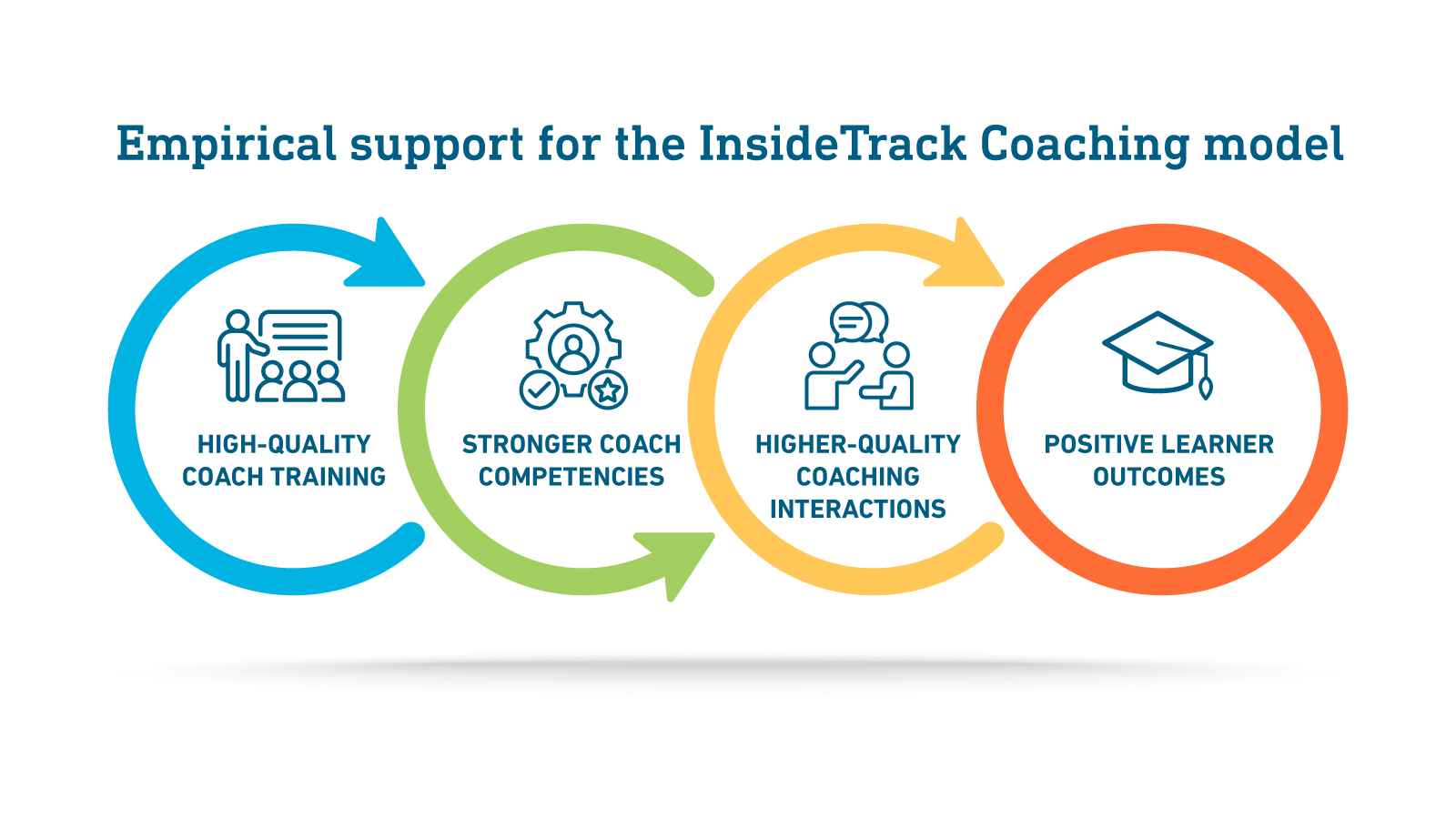
1. High-quality coach training serves as the foundation for effective student support
ICC is centered around five core goals for coaches-in-training:
- Relationship building: Using healing-centered engagement, EI and DQ to establish a safe space for coaching to occur
- Building motivation: Helping learners identify values, recognize progress and connect actions to goals
- Assessing: Prioritizing topics for coaching using active listening and questioning techniques across eight focus areas
- Advancing: Identifying a relevant action plan
- Strategizing: Tailoring support to each individual throughout their coaching experience, based specifically on their needs and personal circumstances
2. Coaches develop stronger competencies as a result of rigorous training
As a result of the in-depth coach training that spans the goals listed above, coaches develop:
- EI and DQ to better meet learners where they are
- Self-efficacy, a goal-oriented mindset and the ability to resiliently impact change by positively influencing others
- Interpersonal reflection and active listening skills
- The capacity to effectively guide and expand their own and their learners’ knowledge, skills and beliefs
- The skills to create strategic plans for each individual based on their starting point
3. These competencies lead to higher-quality coaching interactions
With fortified knowledge, skills and beliefs, coaches can then build an effective coaching environment for learners by effectively:
- Creating a safe environment through healing-centered engagement
- Listening and identifying opportunities for growth
- Guiding learners to create their own goals that align with their educational and career goals
- Developing a concrete action plan to help learners reach those goals
- Building learner confidence and motivation by connecting to their values and recognizing progress
4. Meaningful coaching interactions result in positive learner outcomes
When learners experience high-quality coaching in a safe and supportive environment, they ultimately develop:
- A stronger sense of resilience, belonging and integrated identity
- Self-belief, a growth mindset and the understanding that positive change is possible
- Sharpened listening skills, the ability to prioritize and trust in the coaching process
- Confidence to effectively set and reach goals
- Accountability for their actions and the motivation to overcome adversity
Why trusted human connections drive positive results
The InsideTrack Coaching Model TOC finds that, when coaches meet learners where they are, learners develop the core knowledge, skills and beliefs to help them persist and complete their education. But the impact doesn't stop with a single student.
When staff are trained in InsideTrack’s methodology, a ripple effect is created: the institution is now equipped with an evidence-based framework to support even more learners, leading to widespread impact.
Ultimately, this research reinforces that better coaches drive better learner outcomes. High-quality training provides coaches with the practical tools and insights needed to navigate the complex challenges today's students face. This work is deeply meaningful because it offers validation of a Coaching Model TOC and credibility for rigorous training programs. Because our mission at InsideTrack is centered on advancing student success everywhere, we published this research as an open-source paper. By making this work accessible to everyone, we are inviting practitioners to learn from our methodology and develop a rigorous coaching TOC within their own organizations.
This is the kind of empirically grounded criteria that can enhance coaching practices on a global scale. By investing in a research-confirmed methodology, you are securing the long-term resilience and success of every learner you serve.

Mandalyn Gilles, Ph.D., is the Director of Research Solutions at InsideTrack, where she leads organization-wide research strategies to measure coaching efficacy, evaluate social impact, and drive learner success. With over 15 years of experience in the EdTech and Higher Education sectors, she specializes in transforming high-level organizational goals into actionable research initiatives and evaluating impact. Dr. Gilles holds a Ph.D. in Assessment and Measurement from James Madison University.
If you’re interested in how InsideTrack can help learners persist and complete at your own institution, learn more about our approach to coaching.



Coaching solutions proven to advance all learners
Whether you’re looking to help students persist through completion or to improve career outcomes for job seekers and employees, our holistic coaching solutions can help you achieve meaningful outcomes.